Digital Marketing Roles and Their Key Duties

Choosing a digital marketing career path can feel like ordering off a menu with twenty options and someone saying, “pick one”. SEO, social media, paid advertising, content, analytics, email marketing, strategy – all sound great but what does what mean for what someone does on a day-to-day basis? The good news is that you do not need a grasp of all these areas right away.
A digital marketing career path usually starts off with one area that interests someone, then gaining experience and expanding the skillset. The person who loves to write may gravitate toward content, while the numbers cruncher goes down the SEO path, and the trend-spotters can head toward social media.
This is a guide to the top digital marketing roles, with what they involve, the skills needed, common responsibilities, career growth and salary expectations, and how a beginner can navigate their learning without feeling completely lost.
Whether the reader is a student, fresher, career-changer, B.Com graduate, an MBA, or building a portfolio, the aim is to understand the roles and build their skills for the desired role.
Table of Contents
- What Is a Digital Marketing?
- Top 5 Digital Marketing Roles
- Digital Marketing Executive
- SEO Specialist
- Social Media Marketing Specialist
- Google or Meta Ads Specialist
- Content Marketing Specialist
- Digital Marketing Roles and Responsibilities Compared
- What Skills Do You Need to Work in Digital Marketing?
- How to Start a Career in Digital Marketing
- Digital Marketing Career Growth and Salary
- What is the future of Digital Marketing?
- Common challenges beginners face.
- Conclusion
- FAQs
What Is a Digital Marketing?
Digital marketing includes the ways in which brands, products, services or ideas can be promoted through channels, such as search engines, social media platforms, websites, emails and online advertising.
The role of a digital marketing team is far bigger than just “posting on Instagram”.
A modern digital marketing team may include research into keywords, blog creation, Reel production, Google Ads, website analytics, A/B testing, backlink generation, email marketing execution and delivery of reports to the manager.
That is why there are different types of digital marketing roles. Some digital marketing professionals are deep into one discipline while others work across multiple channels.
An SEO Specialist focuses on organic traffic. A Social Media Marketing Specialist works with channels and engagement. A Paid Ads Specialist looks at advertising opportunities. A Content Marketing Specialist focuses on content creation to help attract and educate audiences. A Digital Marketing Executive may work across multiple channels. The roles can overlap in a start-up or small agency where one digital marketing employee may wear three or four hats before lunch.
Top 5 Digital Marketing Roles to Explore in 2026
Here are five digital marketing career paths that could be practical options for a career understanding before choosing a direction.
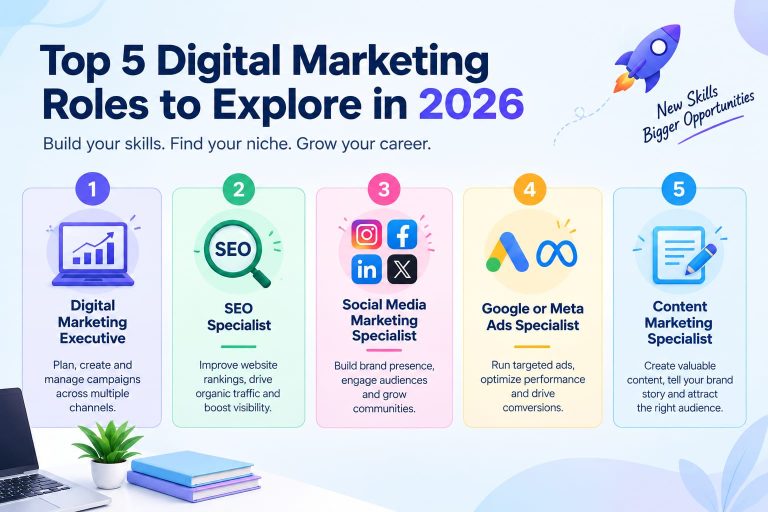
1. Digital Marketing Executive
What does a Digital Marketing Executive do?
A Digital Marketing Executive is often the jack of all trades, spending their day across multiple platforms. This can see them switching between social media, SEO, content creation, email marketing, advertising, analytics and competitor research throughout the day. That makes the job perfect for marketing roles for beginners because it exposes a newcomer to multiple aspects of a campaign.
Key Skills
A Digital Marketing Executive may need:
- SEO fundamentals
- Social media marketing
- Search Engine Marketing
- Keyword research
- Backlink building
- Google Ads
- Meta Ads
- Email marketing
- Canva
- Google Analytics
- Market and competitor research
- KPI tracking
- Basic Excel or Google Sheets
Main Responsibilities
Typical responsibilities can include:
- Planning and executing media campaigns.
- Creating content calendars.
- Writing captions, micro-blogs and basic website content.
- Supporting on-page and off-page SEO.
- Conducting keyword research.
- Maintaining backlinks.
- Preparing email campaigns and automation workflows.
- Setting up. Monitoring paid campaigns.
- Researching. Market trends.
- Tracking metrics such as reach, CPC, conversions and ROI.
- Preparing marketing reports.
Who is this role best for?
Choose this path if you enjoy a variety and do not want your workday to be stuck within one channel. It can also be a starting point if you are still between SEO, social media, content and paid advertising.
2. SEO Specialist
What does an SEO Specialist do?
If a website is a shop on a crowded street, SEO is part of the work done to ensure people can actually find that shop.
An SEO Specialist helps to ensure a website appears in search results when people look for things online. Think of a website as a shop on a street. If people cannot find the shop, it will not get customers. SEO is the work that helps people to find the shop.
An SEO Specialist creates visibility on a website in search engines, such as Google. They work on areas of: content, keywords, technical setup, links and performance data. This role is well-suited for people who enjoy research, paying attention to detail, solving problems and seeing the clear results.
Key Skills
For someone just starting out the important SEO skills include:
- Keyword research – finding the words and phrases people type into search engines.
- On-page SEO – ensuring the content and structure of a webpage are search engine friendly.
- Off-page SEO – building quality links from other websites to boost authority.
- Technical SEO basics – fixing site speed, mobile-friendliness and other site health issues.
- Content optimization – making sure content is useful and matching what users are looking for.
- Link building – getting other sites to link to your site in a natural way.
- Competitor research – seeing what others in the same field are doing well.
- Google Analytics – using data tools to track traffic and behavior.
- Search performance analysis – checking how well keywords are ranking.
- SEO audits – reviewing the website for issues that could hurt search visibility.
- Basic reporting – showing results in a way to others.
Main Responsibilities
An SEO Specialist might do the following tasks:
- Research the search terms related to the business.
- Optimize web pages and blog posts with the right keywords.
- Improve titles, headings and meta descriptions to make them more appealing.
- Run website SEO audits to find problems.
- Build and manage high-quality backlinks.
- Look at competitor websites to understand what works.
- Track rankings and organic traffic over time.
- Watch click-through rates and conversion numbers.
- Find ways to improve content and make it more useful.
- Create reports that show how SEO is helping the website.
Example
Imagine a website about education publishes an article on MBA admissions. An SEO Specialist would look into what students are searching for, such as “best MBA programs for working professionals”. They would then optimize the article based on the search terms, structure the page to make it clear and add links and to check if more people can start finding the page through Google. The goal is to not just stuff keywords into the article but connect what users are seeking to content that helps them as well as a smooth website experience and measurable results.
SEO Specialist vs Digital Marketing Specialist
An SEO Specialist concentrates on organic search and the improvement of a website’s visibility, in search engines. A digital marketing specialist covers a range of areas, including SEO, social media, email marketing, paid ads, content creation and analytics. So while an SEO Specialist dives into one area, a digital marketing specialist works across many digital channels.
3. Social Media Marketing Specialist
What does a Social Media Marketing Specialist do?
Social media is where I see brands stop talking at audiences and start talking to them. I see a Social Media Marketing Specialist plan content, manage channels, study audience behavior, talk to followers and measure performance.
I think the role can bring together creativity, communication, trend awareness, analytics and advertising.
Key Skills
Useful social media marketing skills include:
- Social media strategy
- Content planning
- Copywriting
- Canva
- Short-form video concepts
- Community management
- Influencer marketing
- Meta Ads
- Basic SEO
- Google Analytics
- Creative research
- Performance reporting
Common platforms can include:
- YouTube
- Quora
The exact mix depends on the audience and the business.
Main Responsibilities
A Social Media Marketing Specialist may:
- Create monthly content calendars.
- Plan posts, Reels, Stories, and videos.
- Write captions and social copy.
- Monitor comments, DMs, and audience interactions.
- Research trends and competitor activity.
- Coordinate influencer campaigns.
- Support social advertising campaigns.
- Track reach, engagement, clicks, and conversions.
- Analyze content performance.
- Prepare social media reports.
A simple example:
Imagine a skincare brand launching a product.
The Social Media Marketing Specialist might plan Reels, create product-focused posts, collaborate with creators, respond to comments, test different content formats and review which posts generated the strongest engagement.
The creative idea gets attention. The analytics explain whether that attention was useful.
4. Google or Meta Ads Specialist
What does a Paid Ads Specialist do?
Organic reach can be a long journey. Paid advertising provides businesses a path to reach specific audiences.
A Google or Meta Ads Specialist is building, overseeing, examining. Improving advertising campaigns with a focus on measurable outcomes. The role blends marketing psychology with numbers.
Key Skills
A paid advertising professional should understand:
- Meta Ads Manager
- Google Ads
- Audience targeting
- Campaign objectives
- Budget management
- Ad placements
- A/B testing
- Ad copy
- Creative formats
- CTR
- CPC
- Conversion rate
- ROAS
- Excel or Google Sheets
- Conversion tracking
Main Responsibilities
Typical responsibilities include:
- Creating and launching advertising campaigns.
- Defining target audiences.
- Setting campaign budgets.
- Testing creatives and copy.
- Comparing audiences and placements.
- Monitoring CPC.
- Tracking conversions.
- Adjusting campaigns based on performance.
- Preparing reports.
- Recommending optimization opportunities.
What makes this role different?
A paid advertising specialist cannot just launch an ad and walk away.
Campaign performance can change. Audience behavior changes. Costs change. Creative fatigue can appear. A campaign that did well last month may suddenly need a new approach.
That means testing and optimization are central to the job. Campaign performance can change. Audience behavior changes. Costs change. Creative fatigue can appear. A campaign that did well last month may suddenly need a new approach. That means testing and optimization are central, to the job.
5. Content Marketing Specialist
What does a Content Marketing Specialist do?
Content marketing is the engine that tells stories for digital campaigns.
A Content Marketing Specialist. Manages useful content marketing to attract the right audience, answer their questions, build trust and support business goals.
Content can include:
- Blog posts
- Guides
- Social media content
- Videos
- Infographics
- Email content
- Case studies
- Landing page copy
- Lead magnets
Key Skills
Important content marketing skills include:
- Content writing
- Editing and proofreading
- Storytelling
- SEO writing
- Keyword research
- Content planning
- Audience research
- Managing editorial calendars
- Basic analytics
- Social media understanding
- AI content workflows
Main Responsibilities
A Content Marketing Specialist may:
- Develop content ideas based on the needs of the audience.
- Create calendars.
- Edit content.
- Coordinate with designers and social media teams.
- Optimize content for search.
- Update content.
- Maintain brand voice and consistency.
- Research industry trends.
- Monitor content performance.
- Support campaigns, with blogs, guides, visuals and other assets.
Why is content marketing important?
A brand can spend money to bring visitors to a website. If those visitors find thin, confusing or irrelevant content, the campaign can lose momentum.
Good content provides the audience a reason to stay.
Digital Marketing Roles and Responsibilities Compared
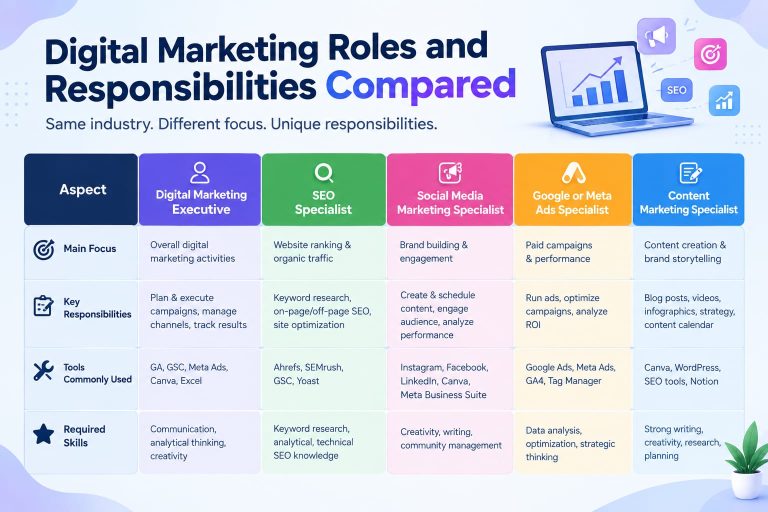
Role | Main Focus | Key Skills | Typical Work |
|---|---|---|---|
Digital Marketing Executive | Multiple channels | SEO, SMM, Ads, Analytics, Email | Campaign execution and reporting |
SEO Specialist | Organic search | Keyword research, on-page/off-page SEO, Analytics | Rankings, traffic, optimization |
Social Media Marketing Specialist | Social platforms | Content, community, analytics, Ads | Posts, Reels, engagement, campaigns |
Google/Meta Ads Specialist | Paid advertising | Targeting, testing, analytics, budgeting | Campaigns, optimization, ROAS |
Content Marketing Specialist | Content strategy | Writing, SEO, research, storytelling | Blogs, guides, content calendars |
What Skills Do You Need to Work in Digital Marketing?
There is no magic skill that makes someone great. The strongest professionals usually mix knowledge with communication, creativity and analytical thinking.
Technical Skills Needed for Digital Marketing
The exact skills you need depend on the job.
These are some ones:
- SEO
- Keyword research
- Social media management
- Google Ads
- Meta Ads
- Email marketing
- Google Analytics
- Content optimization
- Basic Excel
- Reporting
- Conversion tracking
- Marketing automation
You do not have to be an expert in every single item right away. Focus on the skills that match your target role. Start there. Build from the foundation.
Soft Skills for Digital Marketers
Knowledge helps you get through the door.
Soft skills help you succeed once you’re inside. Important qualities include:
- Communication
- Creativity
- Time management
- Adaptability
- Problem-solving
- Research ability
- Curiosity
- Attention to detail
- Teamwork
- Willingness to experiment
Digital marketing changes fast. Platforms roll out features. People change how they search. Advertising systems evolve. AI tools keep changing the way work gets done. Because of this constant shift, becoming ready to learn is a career skill in itself.
How to Start a Career in Digital Marketing
If you are totally new, you do not need to gather fifteen certificates before applying for your internship. I know how it feels when I started out. A smarter approach is to show that you can actually perform the work.
Step 1: Choose one skill
Pick one starting area:
- SEO
- Social media
- Content
- Paid advertising
- General digital marketing
You can expand later.
Step 2: Learn the fundamentals
Understand the terminology, platforms, workflows and basic metrics that belong to your chosen field. For example, an aspiring SEO professional should understand keywords, search intent, on-page optimization, backlinks, audits and analytics.
Step 3: Build practical projects
This is where learning becomes believable.
You could:
- Create a sample SEO audit.
- Build a social media content calendar.
- Create a mock Meta Ads campaign.
- Write and optimize a blog.
- Develop a competitor analysis.
- Create a monthly performance report.
A portfolio turns “I know SEO” into “Here is what I did.”
Step 4: Look for internships and entry-level roles
Search for digital marketing job titles, including:
- Digital Marketing Executive
- SEO Executive
- SEO Specialist
- Social Media Executive
- Social Media Specialist
- Content Writer
- Content Marketing Specialist
- PPC Executive
- Paid Ads Specialist
- Digital Marketing Associate
Do not limit yourself to one title.
Step 5: Keep learning while working
Once you enter the industry, your learning does not stop.
Successful digital marketers continually:
- Monitor platform changes.
- Study campaign results.
- Test new approaches.
- Learn new tools.
- Improve existing skills.
- Understand changing audience behavior.
Digital Marketing Career Growth and Salary
One of the biggest questions of beginners is about digital marketing salary.
The honest answer is that there is no universal number.
Pay can vary significantly based on:
- Location
- Experience
- Company size
- Industry
- Role
- Technical expertise
- Portfolio
- Performance
- Agency vs in-house work
For example, an entry-level social media role and an experienced paid advertising specialist can have very different compensation because of the differences in responsibilities and commercial impact.
Instead of choosing a career based on salary, look at the earning potential of the skill set you are building.
What can improve your earning potential?
Developing deeper expertise in areas such as:
- Performance marketing
- SEO
- Analytics
- Marketing automation
- Conversion optimization
- Content strategy
- Paid media
- AI-assisted marketing workflows
can make your profile more valuable over time.
The strongest approach is to combine one core specialization with supporting skills.
For example:
SEO + Content
or
Social Media + Paid Ads
or
Content + SEO + Analytics
That combination can make you more versatile without turning you into a one-person marketing department on day one.
What Is the Future of Digital Marketing?
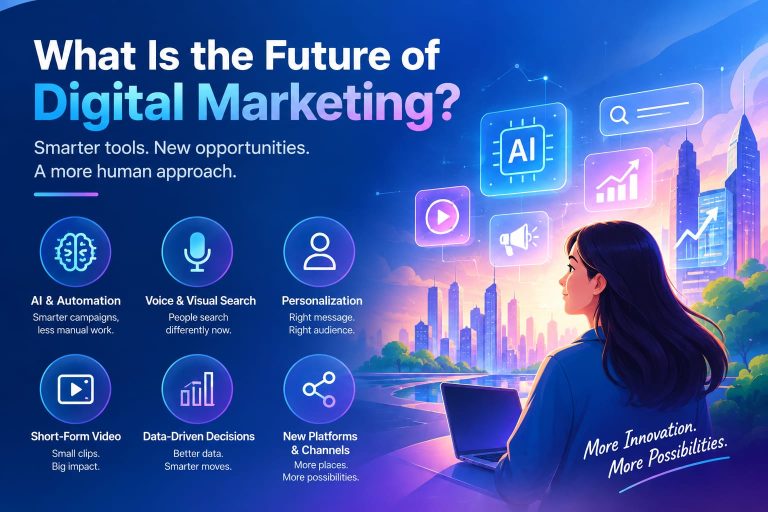
AI is changing how marketers work, but that does not mean every marketing job disappears.
AI can help with:
- Brainstorming
- Research
- Content drafts
- Data organization
- Workflow automation
- Audience analysis
- Creative variations
- Reporting support
But marketers still need to decide:
- What should we communicate?
- Who should we communicate with?
- Why would they care?
- Which channel makes sense?
- How should the result be measured?
That is where strategy, judgment, creativity, and human understanding remain important. The future marketer is therefore likely to be someone who can use technology without surrendering their ability to think.
Common Challenges Beginners Face
Starting a digital marketing career can be exciting but comes with predictable pain points.
“There are too many tools.”
You do not need every tool. Choose tools that fit your role. Feel comfortable, with tools.
“I have no experience.”
Create projects. A mock campaign, SEO audit, content calendar, competitor analysis, or analytics report can demonstrate your thinking.
“I know theory but cannot do the work.”
Move from tutorials to practice. Learning should quickly become:
Learn → Apply → Measure → Improve → Document
“I do not know which specialization to choose.”
Experiment with two or three areas through small projects. Your preferences often become clearer after doing the work rather than just reading about it.
Conclusion
A digital marketing career is not a road with one destination. A digital marketing career is like a network of connected routes. You can start with SEO. Then move into content creation. You can begin with media and then learn paid advertising. You can start as a Digital Marketing Executive. Later specialize. You can progress from a specialist to a manager, build a freelance career or move toward strategic leadership. The first important step is not to try to learn everything. Pick one direction. Build skills. Show proof of your work. Learn from the results. Then broaden your knowledge. If you are still deciding where to begin, look at the five roles mentioned: Digital Marketing Executive, SEO Specialist, Social Media Marketing Specialist, Google or Meta Ads Specialist and Content Marketing Specialist. Your first role does not have to shape your career. It only needs to give you experience to find out what you are good at, what you enjoy and where you want to go next. That is the beginning of a digital marketing career path.
FAQs About Digital Marketing Careers
1. What are the roles in Digital Marketing?
Common roles are Digital Marketing Executive, SEO Specialist, Social Media Marketing Specialist, Paid Ads Specialist, Content Marketing Specialist Email Marketing Specialist, Marketing Analyst and Digital Marketing Manager.
2. Is Digital Marketing a good career?
Yes it can be a good career option for people who like creativity, technology and learning all the time. Your success will depend on the specialization you pick the skills you have the experience you gain and the industry you work in.
3. What does a Digital Marketer do?
A digital marketer may plan campaigns, create content, manage social media, support SEO, run advertisements, analyze performance, research competitors, and report marketing results.
4. What skills do you need to work in Digital Marketing?
Helpful skills are SEO, content writing, social media marketing, paid advertising looking at data, email marketing, research talking to people, creativity and simple data analysis.
5. How do I start a career in Digital Marketing?
Pick a specialization learn the basics build real projects create a portfolio get internship experience and keep learning while you apply for entry‑level jobs.
Check out our latest blogs post- BLOG
Follow us on other platforms- LinkTree