
What Is SEO? How It Works and Why It Matters
Imagine building an amazing website, providing the information people need, publishing articles that answer questions that people are asking… and nobody finds it.
That is what SEO (Search Engine Optimization) is for.
Because when people enter a question, a product, a service, or a problem they are facing in Google search, there may be thousands of pages competing for a position on the first page of search results.
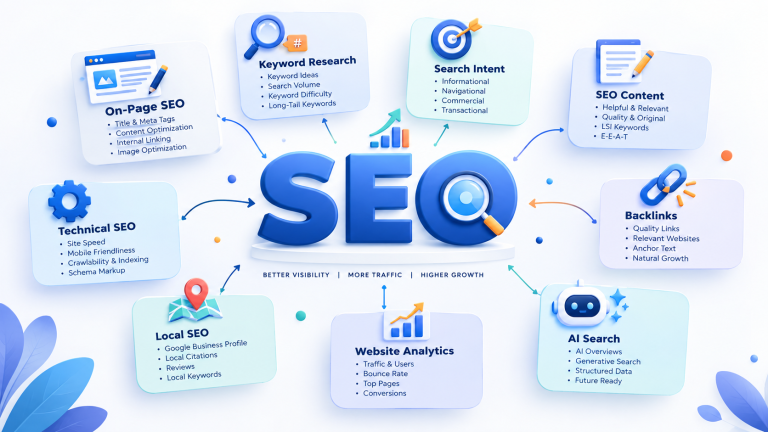
SEO enables a website to appear or be discovered by more people searching on Google. However, SEO is not just about keyword placement on a website. Because SEO encompasses a lot more, from content, technical aspects, website structure, links, search intent, and much more besides.
In addition, as we move toward an age of artificial intelligence and natural language processing, SEO is also about optimizing for AI searches and voice searches. In this article, you will get to know what is SEO, how SEO works, SEO types, why SEO is important, keyword research, SEO tactics and techniques, and best practices for SEO, and how to build sustainable SEO strategies to rank organically on Google search engine results pages (SERPs).
Table of Contents
- What is Digital Marketing?
- What is SEO?
- How Does SEO Work?
- Why is SEO Important?
- What are the Different Types of SEO?
- On-Page SEO
- Off-Page SEO
- Technical SEO
- Local SEO
- What are SEO Methods?
- What are Keywords in SEO?
- What are the Types of Keywords?
- How Long Does SEO Take to Work?
- SEO Best Practices for Beginners
- How SEO Is Changing With AI Search
- SEO vs Paid Advertising
- How to Do SEO for Beginners
- Conclusion
- Frequently Asked Questions
What is Digital Marketing?
Digital marketing refers to the strategy, implementation, and analysis of marketing campaigns through electronic and digital channels such as search engines, social networks, websites, mobile phones, and email. Its main aim is to reach the target audience and influence their choices to achieve a greater conversion rate.
In other words, it is a process of communicating the right offer to the right person at the right time and using the collected information to maximize investment. jj
What is SEO?
SEO stands for Search Engine Optimization.
Search engine optimization, also known as SEO, is the set of strategies and tactics used to optimize a web site and its contents such that it can be indexed by search engines and appears in relevant unpaid searches made via such engines.
In other words, SEO increases the visibility of your website because it appears in the search results when an Internet user looks for information related to the activity offered on our website.
An example of SEO can be, if someone does a search on Google for “best digital marketing course for beginners”.
The site that has information related to this question and takes care of SEO will appear in the search results since it has optimized content, correct structure and technical characteristics, proper keywords, and other factors that indicate to Google that this is a credible and relevant source.
Thus, SEO links three aspects:
- What our customers are looking for
- What our website offers
- What search engines “think” about the website’s content
The results of this work will allow the site to appear in the search results without paying for each click on the link, since, unlike Pay-Per-Click advertising, SEO does not require paying for each visitor.
However, it should be emphasized that SEO requires a considerable amount of effort and work, including research, optimization, technical maintenance, and content creation.
SEO in digital marketing
Search Engine Optimization (SEO) is an integral area of digital marketing because search can bring the right people to the business which are looking for the specific niche.
A successful marketing campaign should not be based only on one particular niche, and SEO could be combined with social media, email, paid advertising, content, influencer, and several other marketing types.
How Does SEO Work?
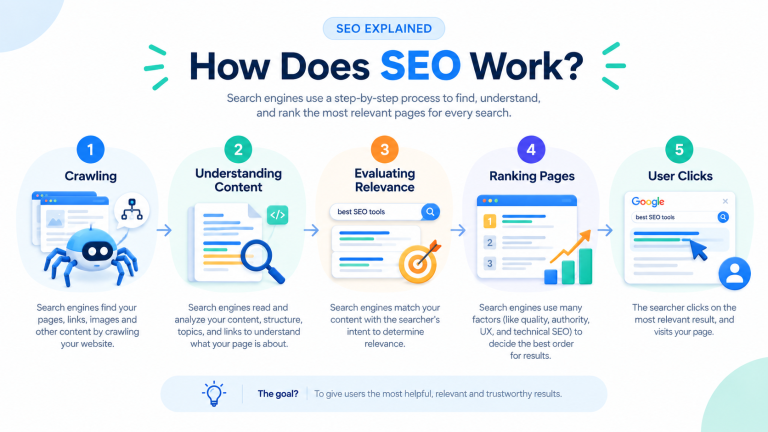
Think of Google searching for an answer to a particular question:
“Which of my available pages is the most relevant for this particular search?”
SEO helps to give the signals to decide what is the most relevant search result.
Now, let’s break the process down into steps.
Step 1: The search engines find your pages
Search engines have a process of crawling sites and finding all of your pages, links, images, and more.
Having a proper site structure, internal links, and XML sitemap will make this step a lot easier for search engines, and therefore, your SEO.
Step 2: The search engines understand the content
Search engines read the text, structure, topics, entities, internal and external links, and other elements on a page in order to understand what a page is about.
This is why stuffing keywords is not a good way to optimize your page, while having SEO-friendly content is.
Step 3: The search engines evaluate relevancy
In other words, search engines try to understand the searcher’s intent.
For example:
Search query | Search intent |
“what is SEO” | Informational |
“best SEO tools” | Commercial |
“buy SEO course” | Transactional |
“Semrush login” | Navigational |
Matching the searcher’s intent is one of the main points of SEO.
Step 4: The search engines rank your page
There is a lot of different criteria that search engines use in order to rank your page higher.
Among those are:
- Relevancy
- Query matching
- Content quality
- Page experience
- Technical accessibility
- Website authority
- Links and references
- Freshness (in case of news)
- User’s intent
- And others
Step 5: The users choose the most relevant result
The last step is clear – the searcher has clicked through to the result that they like the best.
Therefore, it is essential to ensure that your page’s title, description, and content match their query.
How does SEO work with Google?
There is no secret formula for higher positioning. In fact,
Google’s algorithm is designed to answer any question a user can ask.
Therefore, the best way to optimize is to focus on content, relevance, technical optimization, and credibility rather than trying to find some type of secret sauce.
Why Is SEO Important?
If your audience cannot find your website, an incredible product and content go unnoticed. Thus, why is SEO important becomes a matter of business, rather than a technical concern.
SEO can be utilized for:
- Driving awareness of one’s website
- Attracting organic traffic
- Improving website ranking
- Appearing in search results of users with specific search intent
- Boosting brand recognition
- Facilitating lead generations
- Enhancing website’s reputation
- Improving the user experience
- Building long-term digital marketing strategy
SEO can create sustainable traffic
Paid Advertising Can Drive Traffic To Your Website While The Campaign Is Live.
Articles That Rank Well In Search Results Can Attract Leads After They Are Published As Long As The Page Continues To Deliver Value To The Users, Stay Competitive, Be In Good Standards, And Be Updated From Time To Time. However, That Does Not Mean That Search Engine Optimization Efforts Are Completely Free.
It Still Takes Time And Money To Create And Maintain Content.
SEO helps businesses understand customers
One of the less obvious sources of value in search engine optimization lies in the information that can be gleaned from it.
Keyword research can highlight:
- The types of questions they ask
- The problems they describe
- The comparisons they make
- The language they use
- The topics they discuss
- The buying stages they are in
SEO can serve a dual purpose as both a research and a distribution channel.
What Are the Different Types of SEO?
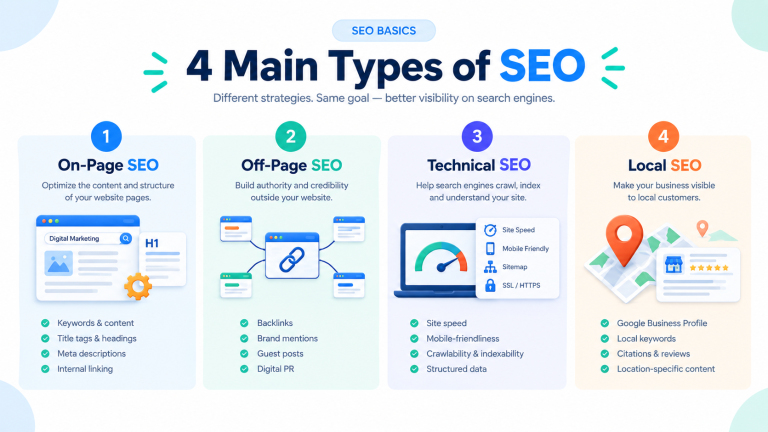
There are several ways to classify types of SEO, but four commonly discussed areas are:
- On-page SEO
- Off-page SEO
- Technical SEO
- Local SEO
These areas overlap. Strong SEO usually comes from combining them rather than treating each one as an isolated activity.
What Is On-Page SEO?
On-page SEO refers to factors that may be optimized on a page-by-page basis.
These are the essential elements of on-page SEO that must be optimized:
- Page titles
- Headings
- Keywords
- Search intent
- Content
- URLs
- Internal pages
- Images
- Alt text
- Readability
- Meta description
For instance, if the page is about introductory SEO, then the title, headings, initial paragraphs, examples, and other sections must clearly state that the page is about the basics of search engine optimization.
On-page SEO vs off-page SEO
The simplest distinction is:
On-page SEO | Off-page SEO |
Happens on your website | Happens outside your website |
Content optimization | Link building |
Headings and titles | Brand mentions |
Internal linking | Digital PR |
Image optimization | Outreach |
Search intent | Reputation signals |
Both contribute to a broader SEO strategy.
What Is Off-Page SEO?
Off-page SEO refers to activities carried out away from your website that can contribute to authority, reputation, and visibility.
One of the most recognizable examples is backlinks.
A backlink is a link from another site pointing to your site.
But the quantity should not be the primary objective. In fact, relevant and reliable links are often more valuable than dozens of spammy links.
Other off-page activities include:
- Digital PR
- Brand mentions
- Relevant guest contributions
- Influencer relationships
- Reviews
- Local citations
- Genuine industry references
The key is to build real authority and avoid artificial link-building schemes.
What Is Technical SEO?
Technical SEO refers to website elements that influence its crawling, rendering, and indexing by search engines and ensure a good user experience (UX).
Key elements include:
- Mobile-friendliness
- Website speed
- Core Web Vitals
- Site structure
- XML sitemap
- robots.txt
- HTTPS
- Broken links
- Redirects
- Duplicate content
- Structured data
- Among others
For example, a technically perfect site with well-optimized content may still underperform if it is not mobile-friendly or has a poor UX structure.
What Is Local SEO?
Local SEO is the practice that makes your business found by searchers who are interested in what you offer in a specific place.
Local SEO is great for restaurants, clinics, saloons, institutes of education, retail stores, service companies, and any other business that has a physical address and serves people in a particular area.
The common local SEO practices include:
- Optimizing Google Business Profile
- Keeping information accurate
- Using local keywords
- Building citations
- Collecting reviews
- Producing location-specific content
- Earning local backlinks
- Making sure websites are mobile-friendly
For example, when someone is looking for a digital marketing institute nearby, they have a different intention than those who googled ‘what is digital marketing’ – and the two should be treated differently.
What Are SEO Methods?
SEO methods are often described using three categories:
White Hat SEO
White Hat SEO refers to the search engine optimization techniques that are fully compliant with search engine guidelines.
Examples of such practices include:
- Development of original content
- Thorough keyword research
- Effective website organization
- Internal linking
- Mobile-friendly design
- High-quality backlinks
- Overall excellent user experience
These ultimately provide sustainable value.
This is the most risk-free strategy that is perfectly compliant with the rules.
Black Hat SEO
Black Hat SEO refers to techniques used to manipulate results.
Examples of such practices are:
- Cloaking
- Hidden text
- Spamming
- Creating pages with automatically generated text
- Redirecting
The use of these methods is fraught with risks and can be detected by search engines.
Gray Hat SEO
Gray Hat SEO refers to tactics that fall somewhere in between.
They might include:
- Aggressive link exchanges
- Over-optimization of anchor text
- Other questionable techniques
The simplest way to define gray hat SEO is to say that if it prioritizes manipulation of the search engine above serving the user, it is a gray hat technique.
What Are Keywords in SEO?
Keywords are words or phrases that are used in search queries. SEO professionals use keywords to understand what the audience is interested in, comparing, buying, or looking for information about.
For example, keywords can be different:
- Short keywords: SEO
- Specific keywords: SEO for small businesses
- Question-based keywords: how does SEO increase website traffic
The evaluation of the keyword should not be based only on its popularity. It is essential to consider several factors:
- Intent
- Competition
- Relevance
- Search volume
- Value
- Content type
- Audience needs
The most popular tools for keyword research are Google Keyword Planner, Semrush, Moz, and Ahrefs.
What Are the Types of Keywords?
Keywords can be classified according to intent and length.
Keyword types by search intent
Keyword type | User intent | Example |
Informational | Learn something | “how to do SEO” |
Commercial | Compare options | “best SEO tools” |
Navigational | Find a specific website | “YouTube” |
Transactional | Take an action | “buy SEO course” |
Understanding intent helps determine what kind of content should be created.
Keyword types by length
Short-tail keywords
These are broad terms, often consisting of one or a few words.
Example: SEO
They may have high search demand but can also be highly competitive and less specific.
Long-tail keywords
These are longer and more specific phrases.
Example: how to do SEO for beginners
Long-tail queries often reveal clearer intent and can be useful for focused articles and niche pages.
Semantic keywords
Semantic or related terms help provide topical context.
For an SEO article, examples include:
- Organic traffic
- Search engine rankings
- Website visibility
- Keyword research
- SEO content
- Backlinks
- Google search results
- Search intent
- Technical SEO
The purpose is not to repeat related terms mechanically. They should appear where they genuinely help explain the topic.
How Long Does SEO Take to Work?
SEO is not something that can happen overnight.
Based on your research, an initial SEO timeline estimate could be somewhere between 3-6 months for most searches and 6-12+ months for some highly competitive industries.
However, there is no hard and fast rule about what timeline you should expect results within or how soon SEO should start working based on:
- How old your site is
- How competitive keywords are
- How difficult it will be to rank for keywords
- Content quality
- Your backlink profile
- Technical SEO
- Site authority
- Consistency of effort
- How much search demand there is
A brand new site going after a highly competitive keyword should not have the same expectation as an established domain with considerable authority.
That’s why the wrong question to ask yourself or anyone who knows anything about SEO is “how soon can I rank?”
The right question is “what can I improve on a consistent basis to make my website more useful and competitive?”
SEO Best Practices for Beginners
For someone learning SEO basics for beginners it is important to not try to optimize everything. Focus on SEO basics.
SEO basics #1: Understand search intent
Before creating content, focus on understanding the search intent of your audience.
Depending on what they are looking for, the goal of your page will change. If someone searches “what is SEO” your page should focus on explaining SEO. A search for “SEO services” has a different commercial intent.
SEO basics #2: Do keyword research
Research keywords and group them by search intent.
Don’t fall for the trap of choosing keywords by popularity. Instead, make sure to include relevant keywords.
SEO basics #3: Provide genuinely useful information
Make sure that the information you provide is more useful than what your competitors have.
To do this you might want to include:
- Examples
- Original explanations
- Data
- Case studies
- Step-by-step instructions
- Tables
- FAQs
- Expert opinion
SEO basics #4: Optimize on-page SEO
Make sure to optimize your on-page SEO by including relevant keywords in your:
- Title
- Introduction
- Headings
- URL
- Content
- Images (alt text)
Where relevant, also optimize meta tags and description. Don’t keyword stuff.
SEO basics #5: Optimize technical SEO
Improve your technical SEO by looking at:
- Mobile-friendliness
- Speed
- Internal linking
- Crawling and indexability
- Website structure
- Broken links
- Sitemap
- HTTPS
- Structured data
SEO basics #6: Build high-quality backlinks
You should now be able to attract backlinks by having better content. It’s important not to randomly guess but to build relevant high-quality backlinks.
SEO basics #7: Enhance the overall experience of the visitor
Have readable and approachable copy. Ensure that everything on your website is functioning correctly. Make it simple to find what you want and navigate. Speed up your website. Improve the experience of users by incorporating images and other media.
SEO basics #8: Measure and analyze
Measure and analyze the results by using Google search console and other tools.
Look at:
- Clicks
- Impressions
- Queries
- Organic traffic
- Rankings
- Conversions
- Technical issues
SEO works best as a cycle:
Research → Create → Optimize → Publish → Measure → Improve
How Is SEO Changing With AI?
Search is no longer confined to the ten blue links. AI-enabled searches, conversational, AI Overviews, and answer engines have entered the game.
This is why we need to be familiar with such terms as AEO, GEO, and AIO.
AEO
AEO stands for Answer Engine Optimization. It refers to optimizing content for answer engines and search features.
To optimize for answer engines, one should aim to:
- Use clear headings
- Give direct answers
- Use definition-like language
- Apply FAQs
- Structure the information in a well-defined manner
GEO
GEO means Generative Engine Optimization. It is all about helping generative AI find and use your content.
The fundamentals of GEO include:
- Information that provides original data
- Structure
- Facts
- Examples
- Case studies
- References and mentions
- Topic relevance
AIO
AIO is AI Optimization which aims to make sure that your information is understandable to AI.
It should have a strong topical focus, provide clearly defined information, establish relationships between concepts, and be structured in a way that would allow crawler access.
Note that AIO is not about optimizing for AI ranking directly but rather about making your information machine-readable.
The same goes for AEO and GEO – this does not replace traditional SEO, but rather complements it.
If a website is not optimized for crawlers, has little useful information, and does not have unique data, then optimizing it for answer engines and AI will not be enough.
What Is E-E-A-T and Why Does It Matter?
E-E-A-T stands for:
- Experience
- Expertise
- Authoritativeness
- Trustworthiness
For content creators, these tips help them determine their own credibility and the value of their information.
Ways to improve this include:
- Providing accurate information
- Displaying relevant experience
- Adding author information
- Using credible sources
- Updating out of date information
- Being open about claims
- Keeping the website secure
For SEO content, credibility is essential since users need to be assured that the information they are learning is accurate and trustworthy.
SEO vs. Paid advertising: What’s the difference?
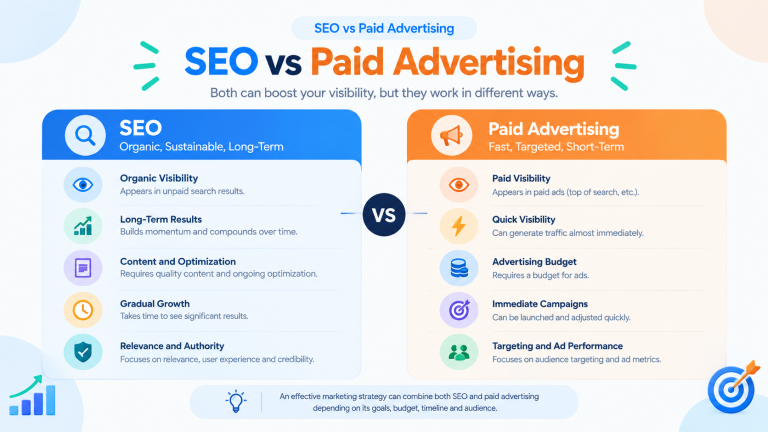
SEO and paid advertising can both boost visibility, but they work in different ways.
SEO | Paid Advertising |
Organic visibility | Paid visibility |
Results can compound over time | Traffic generally depends on campaign spend |
Requires content and optimization | Requires advertising budget |
Can take months to build | Can generate visibility quickly |
Builds long-term search presence | Useful for immediate campaigns |
Strong focus on relevance and authority | Strong focus on targeting and ad performance |
This does not mean that businesses cannot choose between one.
An effective marketing strategy can combine both SEO and paid advertising in accordance with its goals, budget, timeline and audience.
How to Do SEO for Beginners
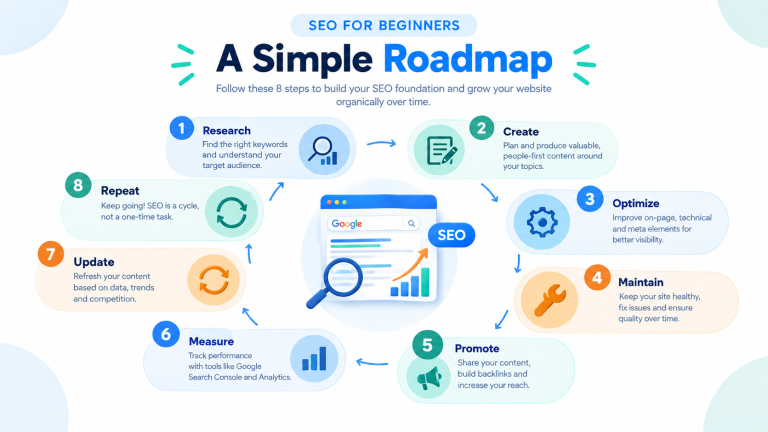
If you are wondering how to do SEO for beginners, the first step is to focus on 1 website + 1 target audience.
A simple beginner-friendly SEO roadmap might look like that:
- Research
- Create
- Optimize
- Maintain
- Promote
- Measure
- Update
- Repeat
SEO for beginners: a simple roadmap
- Define your target audience
- Do keyword research
- Do topical grouping of keywords
- Create content around these topics
- Optimize content (title, headings, URL, media, internal linking)
- Technical optimization of the site
- Content promotion and link building
- Measure in Google Search Console and analytics
- Update existing content based on research/competition/traffic needs
- Repeat the process
This way you build topical authority rather than randomly publishing articles that have nothing in common, which is way more effective for SEO.
SEO Checklist: What Should You Check?
Before publishing an SEO page, run through this quick checklist:
SEO area | Quick check |
Keyword research | Does the topic match real search intent? |
Title | Is it clear and relevant? |
Content | Does it genuinely answer the query? |
Headings | Is the information logically organized? |
Internal links | Are relevant pages connected? |
Images | Are they optimized and descriptive? |
Mobile | Does the page work well on mobile? |
Speed | Does the page load efficiently? |
Technical SEO | Can search engines crawl and index it? |
Trust | Are claims accurate and transparent? |
FAQ | Are common questions answered directly? |
Measurement | Is performance being tracked? |
Conclusion:
SEO used to be relatively simple: help search engines to understand what the webpages are about and find relevant information.
Nowadays, SEO has become more sophisticated.
The importance of SEO lies in search intent, content creation, technical, on-page, and off-page SEO, local SEO, keyword research, backlinks, user experience, authority, and trust, and it is now integrated with AEO, GEO, Artificial Intelligence, and search.
The most common mistake is to look at SEO as a set of tricks to keep spammers away.
SEO is a continuous process that focuses on understanding the audience, creating valuable content, increasing its visibility, building relationships, and measuring results.
For all levels from novice to established and sustainable businesses, SEO knowledge helps to get closer to their audiences, create and manage content, analyze content performance, and ultimately build a successful SEO strategy.
And what is the most important advice for SEO?
Do not chase keywords but aim to create compelling content.
FAQs
1. What is SEO in simple words?
SEO is the enhancement of a website’s properties in order to help it get found by search engines and indexed appropriately in their organic (unpaid) search results; therefore, SEO encompasses both the content and the technical aspects of a site.
2. How does SEO increase website traffic?
SEO may boost a site’s traffic by making the appropriate web content appear for queries that a target audience is searching for, therefore increasing traffic to a site’s web pages.
3. What are the different types of SEO?
The most common types are on-page SEO, off-page SEO, technical SEO, and local SEO. Each of these aspects covers distinct online promotion areas related to the basic principles of website appearance, content, and promotion.
4. How long does SEO take to work?
SEO takes several months to show results. You can expect the fruit of your labor to appear from 3 to 6 months later. However, for highly competitive industries, it might take from 6 to 12 months or more. Everything depends on your industry, the volume of content, technical optimization, and authority.
5. Can I do SEO on my own?
Yes. One can start learning Search Engine Optimization and do a lot of things on their own such as keyword research, content creation and optimization, internal linking, checking some technical aspects of a site and analyzing progress based on specific SEO activities. However, more involved technical issues need to be resolved by an experienced SEO professional or web developer.
Check out our latest blogs post- BLOG
Follow us on other platforms- LinkTree